AI Is Changing the Way Hospitals Get Clean
November 23, 2026
The iPhone took about eight years to get to the point where most people were carrying one. However, generative artificial intelligence (AI) tools such as ChatGPT and Copilot went from being nowhere to everywhere in months.
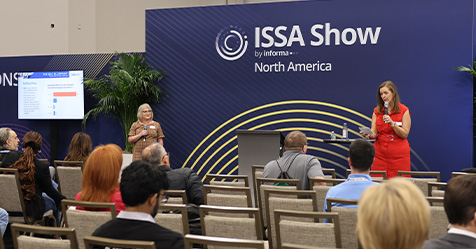
That speed of adoption set the tone for a panel during the ISSA Show North America 2026 presentation Utilizing AI and Innovation in Your Cleaning Operations. Panelists shared their views on how AI is changing cleaning operations in general, and healthcare environmental services (EVS) in particular.
Three of the panelists represented Aramark Healthcare+, including Isaac Johnson, senior vice president of operations, Will Smith, district manager and Mark Heatley, quality and standards director. Tremain Lewis, principal managing partner at Inspire 12, completed the panel.
A quick poll of the room showed that most people were already using AI daily. They described it as being a working part of their day-to-day operations.
For example, hospital EVS managers must balance their staffing plans against patient transport, procedure lists, discharge volume and the weather for the day ahead. AI can take all of those considerations in at once and give users a much clearer picture of what each day will demand.
The panel offered the example of discharge workload at a single site. Rather than going through the records manually, a manager simply fed the data into the AI program and asked for the total. The program returned over 21,000 minutes of discharge cleaning per week across shifts. That figure then became the basis for a completely restructured shift pattern, in line with actual demand.
Seeing patterns people miss
Consistency is key to satisfaction in cleaning as well. A unit that’s consistently the source of complaints every Tuesday may be the result of a recurring staffing gap that no one has linked to the problem. AI can pick up on those patterns and alert the managers so they can get ahead of them.
Sensors and connected devices (IoT or internet of things) add another dimension to the equation. One instance revealed that several complaints about toilets were due to a defective tap, and the complaints ceased once the tap was replaced. In another instance, the data showed patients arrival times were as early as 5 a.m. and 6 a.m., which informed management to have cleaning staff on site earlier. Panelists also referenced real-time location systems as a way to see where the team is and dispatch them to the sites of highest demand.
In response to people’s fear of AI taking over jobs, the panel believes that AI does tedious analysis so leaders can spend more time with their teams. For instance, AI sorted through the results of one engagement survey that garnered over 600 responses, dividing them into the good information and the information that needed work. It then produced an action plan in a tiny fraction of the time it would have taken humans to do a manual review.
Setting a place for executives to start
When beginning an AI use strategy, the panelists advised starting with a baseline. For example, consider how data is used today and determine what rules govern sensitive information such as protected health information (PHI). Healthcare adopts new technology slowly, so persistence matters. Keep presenting the evidence and buy-in will eventually follow.
The group also stressed that AI is still in the learning phase and can produce bad answers, especially if it is given bad inputs. Anything it produces needs to be checked carefully, and each request should focus on a single objective rather than throwing multiple complicated requests at it.
ISSA’s 2027 Board of Directors Takes Office
John Swigart becomes third generation in his family to serve on board
November 23, 2026
ISSA, The Association for Cleaning and Facility Solutions, officially turned its leadership over to John Swigart, president and CEO of Spartan Chemical Company, during the ISSA General Business Meeting held last week at ISSA Show North America 2026 in Las Vegas. Watch the entire meeting here:
At the meeting, the 2027 ISSA board of directors formally took office. See the full 2027 ISSA board of directors listing here.
Swigart spent 2026 as vice president/president-elect and now succeeds Laurie Sewell, who served as president for the past two years.
A family tradition comes full circle
Swigart holds a seat his family knows well. His grandfather led ISSA 51 years ago, and his father, Steve Swigart, served as president 25 years ago.
“I’m the third Swigart to sit in this seat, which is pretty special,” he said.
Earlier in the week, Steve Swigart, chairman of Spartan, received the ISSA Honorary Lifetime Achievement Award during the ISSA Spotlight Event and Awards ceremony.
Swigart was still early in his own career when his father took office. “Being a young guy in this industry 25 years ago, it was cool to watch my mom and dad go through this process and my dad becoming president of the association,” Swigart shared. “It was inspiring.”
His father’s term came with a tough call. In the weeks after the Sept. 11 attacks, ISSA leadership had to decide whether the trade show would go forward. It did, and Swigart pointed to that moment as proof of the industry’s resilience.
Swigart also reminisced about his grandfather. “I know if he were here today, he would be very proud of where our association is,” he said.
Thanking the people around him
Swigart opened his remarks by thanking Sewell, who served on the board alongside his father in 2000 and 2001. She passed along a few stories from those years, which Swigart plans to hold onto. “It really has been an honor serving on the board with her,” he said.
He turned next to Kim Althoff, who is finishing her first year as ISSA executive director after roughly three decades with the association. “Kim has dedicated her life to this association,” Swigart noted. He explained that her institutional knowledge often reframes the board’s conversations. “She makes comments that make everybody else think a little bit differently, and that’s always a good thing,” he added.
Former executive director John Barrett, now chairman emeritus, also got a nod. The two met 10 years ago on Swigart’s first day on the board, as the executive director role passed from John Garfinkel to Barrett. “What you did for the association will always be remembered,” Swigart said to Barett.
Swigart also thanked his wife for standing by him for 25 years, his parents, ISSA staff, the outgoing board members, show partner Informa and the Spartan team.
A shift in ISSA’s attention
Swigart remarked that the association looks much different now, compared to his last stint on the board from 2014 through 2016. At that time, ISSA owned the trade show, which was the association’s main revenue driver and its main focus. Today, the show runs in partnership with Informa.
Swigart was clear that the show still matters a great deal to ISSA. What has changed is where the association puts its energy. “We’re building out teams of people that can enhance our membership experience across a lot of different market verticals and across every single membership class to provide training platforms, education, tools, certifications and advocacy for this wonderful industry,” he explained.
Developing new talent is part of that picture. Swigart mentioned the emerging leaders breakfast held the day before. “Hopefully, some of those folks in that room have some aspirations of their own to get on this board and lead our association one day,” he said.
Built on hardworking people
The cleaning industry has supported Swigart’s family for three generations, and he sees ISSA as the place where it comes together. “ISSA is a conduit that brings our industry together to learn from one another and find ways to better serve our customers,” he said.
“This industry is fun,” Swigart added. “It’s made up of hardworking, like-minded, resilient people.”
Sponsored Articles