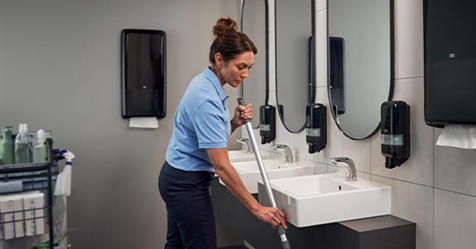
Cleaning: Your First Line of Defense Against Cold and Flu
86% agreed cleaning is essential to ensure healthy public spaces and workplaces
October 21, 2026
A new survey from the American Cleaning Institute (ACI) and the American Academy of Family Physicians (AAFP) found that 91% of respondents said cold and flu illnesses significantly disrupt life. Parents report feeling the disruption across nearly every part of family life, including:
- 61% experienced missed work or school.
- 55% reported impacts to after-school activities.
- 52% dealt with disrupted sleep schedules.
The findings arrive as the country heads into another closely watched respiratory-virus season. The previous two cold and flu seasons produced an estimated 1.1 million combined hospitalizations, according to the Centers for Disease Control and Prevention (CDC), and the CDC projects this winter’s peak hospitalizations from flu and other respiratory illnesses could rival last season, when flu alone accounted for roughly 390,000 hospitalizations.
Against this backdrop, Americans recognize that cleaning matters: 86% agreed it is essential to prevent illness and protect their health or ensure healthy public spaces and workplaces. Yet the survey revealed a gap between awareness and action. Only one in four Americans adjusts their cleaning habits proactively throughout the season. Meanwhile, 28% waited until someone in their home is already sick, which may be too late to help prevent transmission.
“Disruptions from illness can upend daily routines, and cleaning is one of the simplest ways to help stay healthy,” said Jessica Ek, associate vice president, strategic communications at the American Cleaning Institute. “Americans recognize that cleaning is essential for healthy homes and communities, relying on trusted cleaning products to protect their families during cold and flu season.”
EPA Localizes Updated Air Model
October 21, 2026
The Environmental Protection Agency (EPA) released a major update to the Community Multi-scale Air Quality (CMAQ) model, version 6.0, providing the precise data that state, local, and Tribal air agencies need to develop effective State Implementation Plans (SIPs) and meet National Ambient Air Quality Standards (NAAQS). The update will give EPA’s partner air agencies a more accurate, user-friendly platform with enhanced modeling capabilities for ozone, particulate matter and other air emissions. Key updates in CMAQ version 6.0 include:
- Upgraded Chemical Mechanisms: Improved simulations of ozone and secondary organic aerosol (SOA) formation.
- Global-to-Local Scaling: Improved integration of global-scale simulations to fine neighborhood-scale resolutions.
- Enhanced Source/Region Tracking Extensions: Upgrades to tools that give policy managers insights into the source categories and regions that may be contributing most to downwind pollutant impacts.
- Optimized Computational Efficiency: Faster processing times to help agencies save resources.
In addition to supporting regulatory bodies, this publicly available resource reinforces EPA’s strong partnership with the academic community. Researchers and atmospheric scientists worldwide can leverage the updated framework to drive further innovations in air quality science.
To download CMAQ version 6.0 or access the updated technical documentation and user guides, visit the official EPA Photochemical Air Quality Modeling page.
Sponsored Articles