Keeping Up With Labor and Immigration Laws
ISSA Show session puts cleaning leaders ahead of the curve on hiring incentives and immigration policy
November 25, 2026
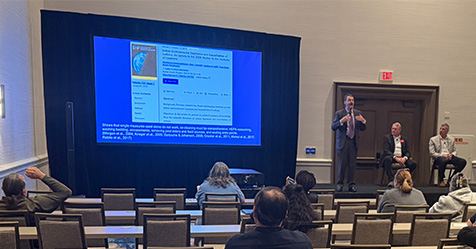
John Nothdurft, vice president of Government of Public Affairs for ISSA, opened his labor laws and immigration policy session at ISSA Show North America 2026 last week by naming the unsurprising challenge that has plagued the cleaning industry for years.
“It’s always been a struggle to bring new people into the cleaning industry and to keep them,” he said.
Nothdurft discussed the Critical Labor Coalition’s top legislative priorities in response to ongoing labor challenges:
- Increase workforce participation rates by broadening Earned Income Tax Credit (EITC) eligibility, extending or making the Work Opportunity Tax Credit (WOTC) permanent and strengthening support for caregivers.
- Grow the pool of legal workers by creating avenues for individuals to enter high-demand jobs, protecting currently and legally employed workers, and streamlining processes to reduce work permit backlogs.
- Strengthen training and apprenticeship programs by prioritizing the Workforce Innovation and Opportunity Act (WIOA), expanding on-the-job training incentives and streamlining, updating and expanding the apprenticeship application process.
- Shape artificial intelligence (AI) policy to support workforce development by providing industry-specific data to policymakers and supporting AI solutions that empower workers to expand their knowledge and transition into higher-value roles.
These priorities are critical as the labor shortage will continue into the unforeseeable future due to multiple factors, including an aging population. “There are fewer enrolled first-grade students than high school seniors in 30 U.S. states,” Nothdurft said, citing numbers from the National Center for Education Statistics.
Another factor in the labor shortage is the decline of male workers, with the U.S. Bureau of Labor Statistics revealing a 6.9% decline in male workforce participation, from a 75.1% participation rate in 2000 to a 68.2% participation rate in 2023. In comparison, female workforce participation declined 2.4% in the same period, from 60.1% in 2000 to 57.7% in 2023.
“The labor force never recovered from COVID-19,” Nothdurft said, explaining that American families saved more than US$2.3 trillion during the pandemic, which inspired many to leave the work force. In addition, the post-COVID-19 era has resulted in a new work/life balance with workers prioritizing more flexibility in their schedules, more opportunities for remote work and the desire the work fewer hours.
Combining these factors with a record number of retirements (2.4 million excess retirees as of April 2023), an increase in new business (5.5 million new business applications in 2023) and social media opportunities (2 million content creators earned six figures through social media platforms), makes the need for new workers even more dire.
To bring more individuals into the workforce, WOTC has been incentivizing workplace diversity and facilitating access to good jobs for underserved workers. WOTC is a federal tax credit available to employers who hire and retain individuals from groups who have consistently faced significant barriers to employment. It reduces an employer’s federal income tax liability.
WOTC-targeted groups include qualified veterans, long-term unemployment recipients, SNAP (food stamp) recipients, qualified ex-felons and supplemental security income (SSI) recipients, along with others.
Other incentives targeting workers include the Essential Workers for Economic Advancement Act (H.R. 5494). This bipartisan house bill creates a new temporary, nonimmigrant visa for individuals to work in nonagricultural skilled positions.
The American Dream and Promise Act Discharge Petition, which needs one more Republican signature for House vote, will ensure that Dreamers and temporary protected status (TPS) holders—long-term, vetted immigrants who have contributed to the workforce for years—get a vote on the House floor. To qualify under the Dream Act portion of the bill, applicants must have been physically present in the U.S. since Jan. 1, 2021, entered the U.S. at age 18 or younger, have a U.S. high school diploma or equivalent, be admitted to college or a postsecondary career/technical program or be currently enrolled in school.
New rules related to work permits complicate employment opportunities for immigrants. In October, U.S. Citizenship and Immigration Services (USCIS) finalized a rule that eliminated automatic work permit extensions to people who were previously eligible for them. Other USCIS actions this year include:
- A notice of proposed rulemaking (NPRM) that would impose restrictions on the processing and issuance of work permits to applicants for asylum.
- An NPRM that imposes restrictions on the processing and issuance of discretionary work permits.
Nothdurft warned business owners and cleaning industry leaders of significant delays in the renewal of worker visas. He advised that affected workers file for a renewal of their visas as soon as possible instead of waiting for their current visas to expire. He also recommended that employers reach out to their Congress representative for assistance if their workers are not getting a response to their visa renewal request.
Extreme Weather Doesn’t Wait for a Business Plan
November 25, 2026
On paper, 2026 looks like a breather. Global insured losses from natural catastrophes were US$92 billion for the first nine months of the year (Jan.-Sept.), according to Gallagher Re. That’s the lowest nine-month total since 2019 and 29% below the 10-year average.
Panelists at the ISSA Show North America 2026 session, Extreme Weather Preparedness: Why Resiliency Is Sustainable, last week in Las Vegas, were very careful not to overinterpret the data. Stephen Ashkin, president, The Ashkin Group; John E. Kelley, senior director, JLL Global IFM; and James Waddell, president, Cognitive Corp., all pointed to a different set of figures.
The total economic losses over that same nine-month period were $242 billion, with approximately $150 billion uninsured on a recorded 23 events in that nine-month period with at least $1 billion in insured damage, well above the 21st-century average of 14 recorded events.
Trouble arrived from unexpected directions
The Atlantic didn’t experience a major hurricane until Isaias in October. However, the bulk of the damage was elsewhere. Winter Storm Fern dumped ice and record cold across over 30 states in January, and in the central U.S. in April, a series of destructive storms—including tornadoes, damaging winds and large hail—caused more than $6 billion in insured losses. For the clean-up and restoration teams, that meant calls for burst pipes, water extraction, cracked floors and roof repairs.
Service businesses run on thin margins, and downtime is very costly. At the 3.6% operating margin ABM Industries reported for FY25, a single day of revenue that can’t be billed is equivalent to losing 28 days of profit. Cash gets depleted very quickly, too. JPMorgan Chase Institute research shows the median small business has about 27 days of cash on hand, and a quarter have less than 13 days of cash on reserve.
The panel asked business owners to imagine a situation in which half their crew was unable to report due to damage at home, then to prioritize which clients came first and where to position people and equipment.
Clients are already asking these questions. The Business Continuity Institute (BCI) found that 75% of organizations do in fact ask their key suppliers if they have continuity arrangements, with only 58% getting a “yes” in response. Preparation for these situations, however, is far less expensive than most business owners think. In a March 2026 U.S. Chamber of Commerce Foundation survey with Verizon of 2,005 small business owners, the vast majority had significantly overestimated the cost of preparation (roughly six times the actual figure).
To help close that gap, the ISSA Sustainability Committee worked with Green2Sustainable and Cognitive Corp. to create the free Extreme Weather Preparedness Handbook. The comprehensive handbook has 12 chapters, covering risk assessment and facility protection through recovery and insurance, and the appendices include checklists, continuity plan templates and a location lookup that links to National Weather Service alerts.
The AI Resilience Companion draws exclusively on the committee-reviewed handbook (not the open internet) to produce answers tailored to the user’s role and location under human supervision.
The timing of these resources is critical. The National Oceanic and Atmosphere Administration puts the odds of a strong to very strong El Niño lasting through winter above 83%, and wetter-than-average conditions are forecast across the South and East. Any contractor with sites in those areas has a few weeks to confirm that a water intrusion response is in place for January.
ISSA members can access the handbook and the AI Resilience Companion free of charge at green2weather.cognitive-corp.com.
Latest Articles
Sponsored Articles