NY Governor Declares State Disaster Emergency in Response to Ongoing Measles Outbreak
New York increases testing and vaccination efforts while neighboring Pennsylvania’s cases top 1,000
October 7, 2026
On Monday, New York Governor Kathy Hochul issued an executive order declaring a state disaster emergency in response to the growing number of measles cases across rural areas of New York and neighboring states. As of Oct. 3, New York state health officials have reported 108 cases of measles among residents in 2026, including 92 cases reported since July 15 among under-immunized, rural communities in 18 counties. Only seven cases have been confirmed in New York City.
Meanwhile, New York’s neighboring state of Pennsylvania is experiencing a rapidly progressing measles outbreak with 1,004 cases and five deaths as of Oct. 5, in rural counties that border New York State.
The governor’s executive order enables the state to respond more swiftly to the outbreak and allows healthcare professionals to take additional steps that will help get more New Yorkers vaccinated and tested, if needed. For example, the executive order specifically extends the pool of eligible individuals who can administer measles vaccines, including paramedics, advanced EMS providers, pharmacists and midwives. In addition to physicians, the executive order also allows nurses to order testing.
The governor also received her seasonal flu shot and urged all New Yorkers to receive this year’s flu vaccine to protect against infection.
“After reviewing the latest data on measles cases in New York State, I am declaring a State Disaster Emergency to strengthen our ongoing efforts to confront this disease,” Governor Hochul said. “No one should get seriously ill or die from a vaccine-preventable disease. That is why I have taken steps to increase the number of health professionals who can vaccinate and test. These emergency measures will protect New Yorkers and support our community partners as they work tirelessly to address the spread of this disease.”
The best protection against measles is the measles, mumps and rubella (MMR) vaccine. Those traveling domestically or internationally should plan to be fully vaccinated against measles at least two weeks before departure. One dose provides 93% protection while two doses provide 97% protection. Since July 15, local health departments have administered over 1,000 doses of the MMR vaccine across rural areas of New York State.
Best States for Waste Management in 2026
October 7, 2026
Which states are trying to cut down on landfill waste, and which are just burying the problem?
To mark leaf season and October as Zero Waste Month, LawnStarter ranked the best states for waste management this year across 27 metrics spanning recycling policy, disposal infrastructure, recycling and composting performance, and total waste output.
The study found:
- Thirty-four states have Extended Producer Responsibility (EPR) laws, requiring manufacturers to provide disposal systems for their products.
- New Hampshire (No. 34) is home to the most municipal solid waste (MSW) landfills per 100,000 residents, 3.4, followed by Montana (No. 49) and Kansas (No. 27) as of 2024.
- Rhode Island (No. 18) has the highest amount of waste in landfills relative to the state’s surface area as of 2024, followed by New Jersey and Delaware.
- Wisconsin (No. 10), Pennsylvania (No. 16), and Iowa (No. 6) were the first states to enact yard waste bans in the early 90s. Twenty-six states currently require yard waste to be disposed of separately from the rest of household trash.
Connecticut ranked No. 1in the study. The state ranks seventh regarding the number of recycling facilities per 100,000 residents and boasts a 39% recycling rate for common containers and packaging materials. Overall, Connecticut has the fifth highest recycling rate for production-related waste, and the fourth lowest share of production-related waste disposed/releases. Connecticut was also the study’s No. 1 state for managing food waste. Food is the single most common material in U.S. landfills, making up roughly 24% of buried material, and it generates 58% of the methane landfills emit, according to the Environmental Protection Agency (EPA). Additionally, the state has enacted six EPR laws in recent year, including for paint (2011), gas cylinders (2022), tires (2023) and batteries (2025).
Ranking second, Vermont is home to the most recycling facilities per 100,000 residents. The state also has the second highest recycling rate for common containers and packaging materials, at 51%. Vermont also ranks second regarding the number of EPR laws, and is tied with Maine in possessing nine laws. In 2023, the state passed the first household hazardous waste EPR law in the country.
Coming in third, New York is home to the fifth lowest number of MSW landfills per 100,000 residents, and the state achieved the sixth highest recycling rate for common containers and packaging materials at 44%. It is among the top 10 states in managing food waste. New York City’s citywide residential composting mandate, in effect since April 2025, is the largest single organics program in the country.
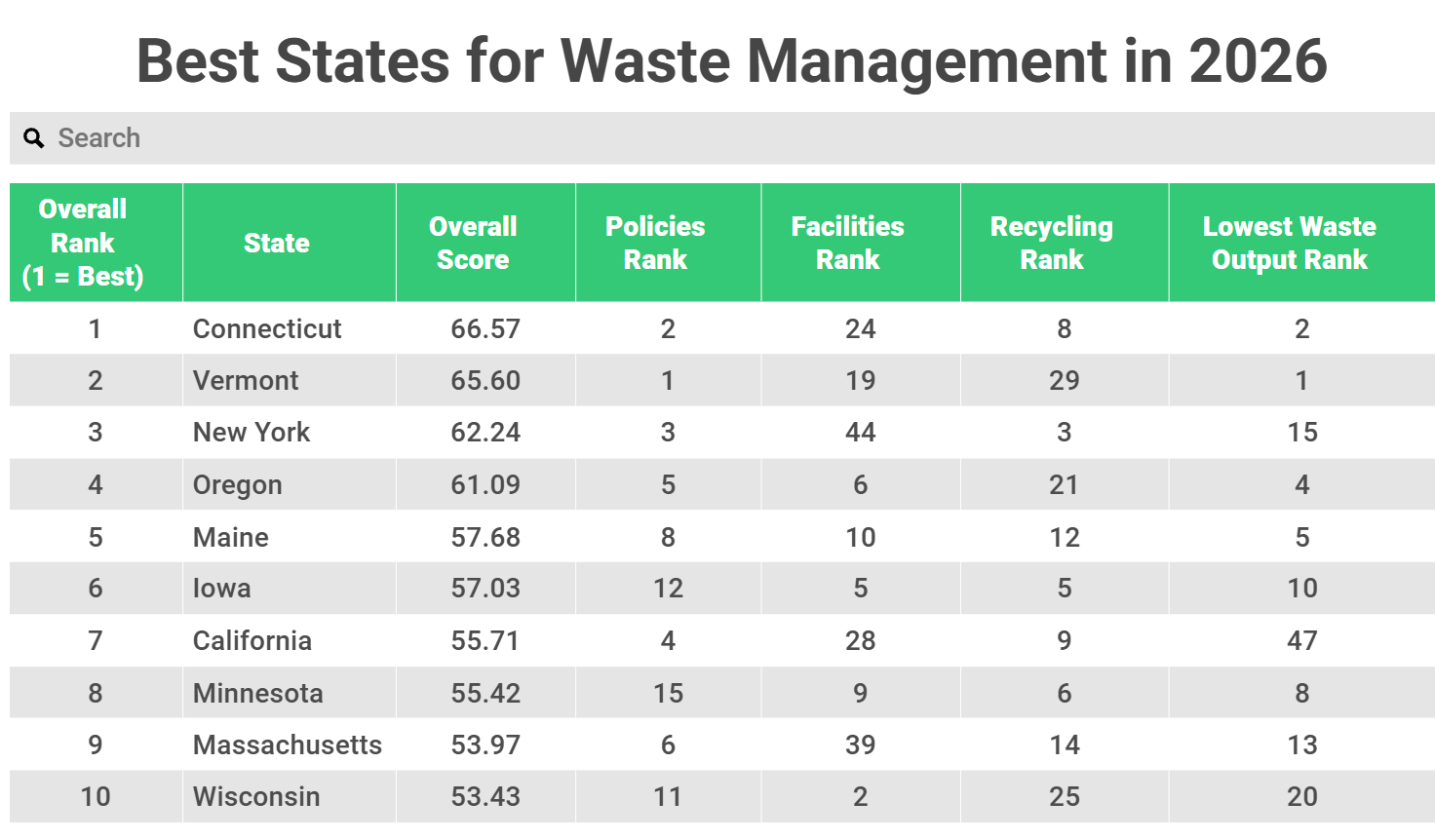
Each state had the potential to earn a score up to 100, built from its performance across four categories—policies, facilities, recycling and lowest waste output. A higher score means stronger, more comprehensive waste management; a lower score points to weaker infrastructure, fewer policies, or higher per-capita waste output.
For example, Alaska (No. 48) isn’t the most wasteful state, but it faces real logistical challenges: With a small, spread-out population, there isn’t enough concentrated waste volume for large investments in in-state recovery infrastructure. Alaska has the lowest share of production-related waste recycled, at just 0.02%. Explore the full methodology.
Yard waste, like grass clippings, leaves and branches, make up about 12.1% of the total waste generated in America—nearly the same amount as plastics (12.2%). However, when it comes to yard trimmings, they can usually be recycled right back into the lawn. The mix of composting, combusting and landfilling yard trimmings through the municipal waste stream created the equivalent of 170,000 cars’ worth of greenhouse gases in 2018, according to the most recent EPA data estimates.
Latest Articles
Sponsored Articles