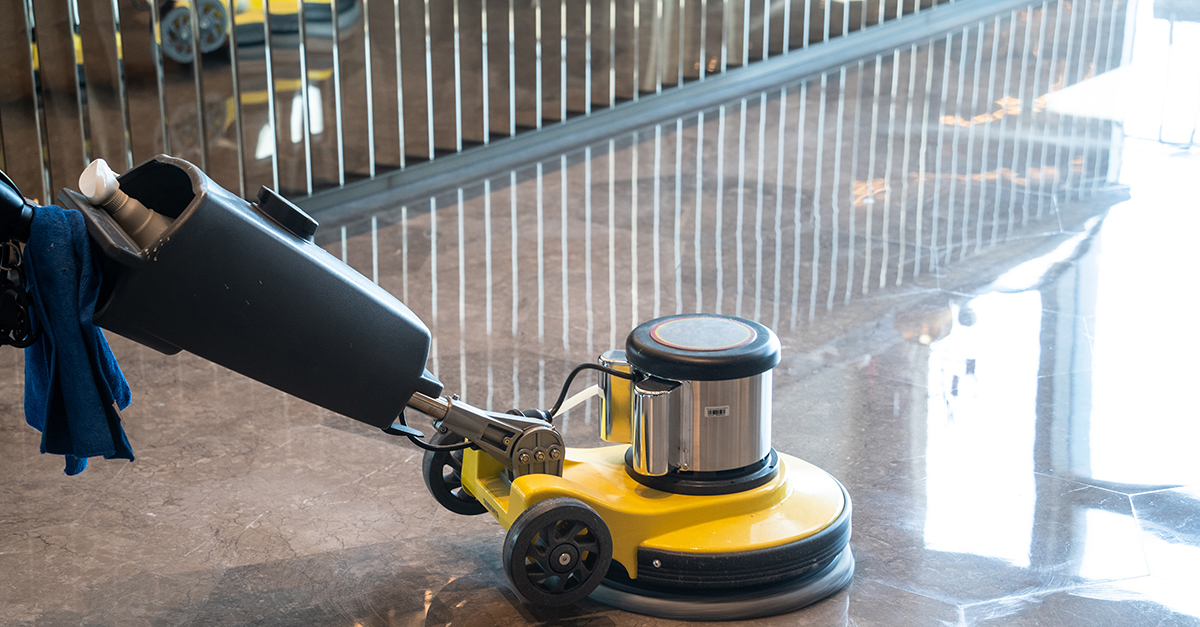
How can a simple floor pad help address labor shortages, rising chemical costs, and safety concerns in commercial facilities? Facility managers responsible for maintaining hard floors in environments such as hospitals, schools, airports, and retail stores face increasing pressure to improve cleaning results while managing limited staff and tightening budgets. As a result, many organizations are reevaluating traditional floor care programs and exploring technologies that simplify maintenance while improving performance.
First introduced in 1989 near Stockholm, Sweden, diamond-impregnated floor pads were originally developed to maintain polished concrete floors. Since then, the technology has evolved to support multiple flooring types, including vinyl composition tile (VCT), polished concrete, and terrazzo.
Diamond pad characteristics
Unlike traditional floor pads, which are primarily composed of synthetic fibers, diamond floor pads are made from a nonwoven material coated with a resin mixture containing microscopic, man-made diamonds. As the pad moves across the floor, the microscopic diamonds create a controlled micro-abrasion process that gradually removes embedded soil and microscopic layers of worn material while simultaneously polishing the floor surface. Repeated cleaning with diamond pads can improve floor clarity and gloss by smoothing the surface, eliminating the need for additional coatings.
In most applications, cleaning crews use the pads with water alone. In environments where sanitation protocols require additional cleaning agents, such as healthcare facilities, crews incorporate pH-neutral cleaners into infection prevention protocols.
Depending on the manufacturer, some diamond pads are coated on one side while others are coated on both sides. Pads with single-sided coating offer greater flexibility during use, as the uncoated fiber layer helps maintain consistent contact with the floor, especially on slightly uneven surfaces. The pad also absorbs machine pressure better, improving operator control.
For facilities managing large areas of flooring, this streamlined approach improves efficiency and reduces the time required for routine maintenance.
Grit levels
Diamond pads are color-coded to indicate grit level, ranging from levels for aggressive floor sealant stripping to high-gloss floor finish polishing. Choosing the appropriate grit sequence depends on factors such as the type of flooring, the floor’s current condition, and the desired final appearance.
The standard diamond pad color system offers a variety of pads for different procedures, including:
- Green (3,000 grit): Designed for daily maintenance, this pad produces a high-gloss finish.
- Yellow (1,500-1,800 grit): Used during the pre-polishing step, this pad removes fine scratches, creates a “wet look” shine, and prepares for final polishing.
- White (800 grit): This pad removes moderate scratches and prepares the surface for polishing.
- Red (400 grit): These pads are more aggressive and used for removing deep scratches, stains, or damage.
Beyond these standard grit levels, manufacturers have introduced ultra-fine pads, ranging from 8,000 to 10,000 grit, which allow for a safe transition from one floor surface to the next.
Streamlined maintenance processes
Maintaining hard floors often involves multiple steps, including scrubbing, stripping, refinishing, and burnishing. Additionally, each stage may require different pads, chemicals, and equipment. Diamond pad systems simplify maintenance by combining cleaning and polishing into a single process. Combining these two steps significantly reduces the need for separate burnishing procedures to maintain a consistent floor appearance. Additionally, the micro-abrasion process helps remove surface contamination, including embedded soils and microorganisms, making it particularly valuable in healthcare environments.
Labor remains the largest cost component in most floor care programs. By combining cleaning and polishing into a single process and eliminating stripping and refinishing cycles, diamond pad systems can help facilities reduce labor hours while maintaining a consistent floor appearance. For facilities managing large areas of flooring, this streamlined approach improves efficiency and reduces routine maintenance.
Improved indoor air quality
Indoor air can be two to five times, and up to 100 times, more polluted than outdoor air, according to the American Lung Association. Floor cleaning chemicals can contribute to indoor air pollution. The Environmental Working Group reports that commercial cleaning products may contain as many as 193 volatile organic compounds (VOCs), which can impact the environment, facility occupants, and cleaning staff.
The technology in diamond floor pads enables cleaning with only water, eliminating the need for hazardous cleaning chemicals, floor finishes, and strippers. Additionally, as the millions of microscopic diamonds refine the floor’s surface, rather than aggressively grinding it, the process releases fewer particles back into the air. Fewer particles lead to better indoor air quality and reduced contamination of HVAC filters.
Enhanced sustainability
Facilities looking to reduce their environmental footprint can implement diamond pad systems into their sustainability initiatives. On average, traditional floor pads last for approximately 25,000 square feet, depending on floor conditions. Diamond pads have a significantly longer lifespan, covering up to 300,000 to 600,000 square feet before replacement is necessary.
This longer lifespan reduces the frequency of pad replacement, generating less waste and reducing the need for larger pad inventories. Fewer pad replacements also mean less interruptions during cleaning operations, particularly in facilities where staff must frequently change worn pads during routine maintenance.
Additionally, the reduced reliance on chemical products can help lower supply costs and support environmental goals. Reduced chemical use may also simplify training requirements and storage considerations for cleaning staff.
Slip resistance
Falls are the second leading cause of unintentional injury-related death, according to the National Safety Council (NSC). NSC’s Injury Facts® reported that in 2024, 48,308 people died in falls at home and at work.
Traditional stripping and refinishing processes often utilize strong chemical solutions that can create slippery conditions during application. By reducing or eliminating the need for stripping chemicals in some maintenance programs, diamond pad systems help minimize temporary slip-and-fall hazards during floor care procedures. Facilities have also reported that floors maintained through mechanical refinement often provide consistent traction compared to floors with heavy coatings.
Changing floor-care perspectives
As facility managers seek to improve efficiency, reduce chemical use, and maintain a consistent floor appearance, diamond floor pad technology offers an alternative to traditional floor care methods. With continued advancements in pad design and compatibility across multiple flooring types, the technology is becoming an increasingly practical solution for maintaining large commercial spaces.