Most Americans Concerned About Infectious Disease Risk in Public Settings

Americans worried about long-term health effects from environmental contamination

May 28, 2026

As infectious disease threats, including reported hantavirus cases in the U.S., continue to draw public attention, a new First Onsite survey found six in 10 Americans are concerned about the risk of infectious disease spread in public settings. This reflects a benchmark in how Americans think about the built environments where they work, travel, and gather—and what they expect from those responsible for keeping those spaces safe.

The survey reported that concern about infectious disease and future pandemics is a central concern of Americans of all ages and regions. Beyond infectious disease, respondents also reported concerns around indoor air quality, hidden building damage, hazardous substance exposure, drug exposure, and the long-term health effects from environmental contamination.

“Concern about indoor environmental risk is no longer episodic—it is baseline,” said Norris Gearhart, executive vice president of regulatory business practice and director at First Onsite’s First Onsite Academy. “What this data shows is that Americans have moved from awareness to expectation. They expect the buildings they occupy to be safe, and they expect the people responsible for those buildings to have a plan.”

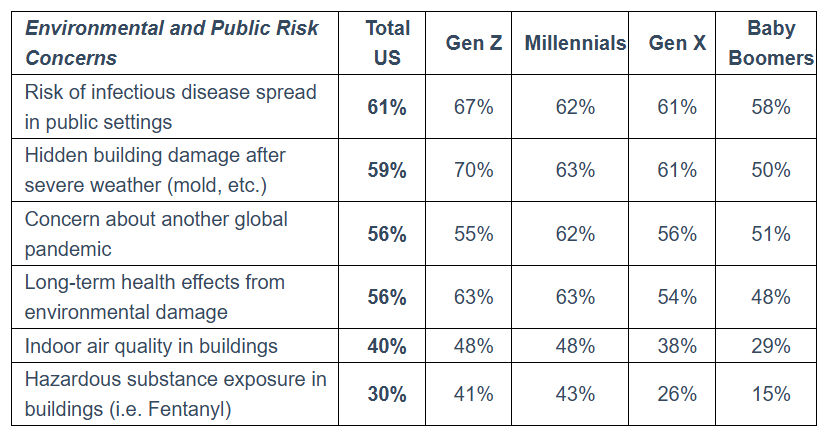
Infectious disease concern tops the survey at 61%, underscoring how firmly public health risk remains embedded in how Americans think about shared indoor environments. Concern about another global pandemic remains widespread at 56%, reinforcing the durability of post-COVID risk awareness.

Hidden building damage (59%) and long-term health effects from smoke, mold, or water damage (56%) follow closely behind, while indoor air quality (40%) and hazardous substance and drug exposure in buildings (30%) represent lower but still meaningful concern levels.

When it comes to hazardous substance and drug exposure in buildings, parents are the most concerned of any group—specifically, respondents with children in the home report concern at nearly double the rate of those without (44% vs. 24%). The generational divide is equally stark. Gen Z (41%) and millennials (43%) express concern at nearly three times the rate of baby boomers (15%), with Gen X (26%) sitting closer to the older end of that spectrum.

While concern levels remain high nationwide, the risks that feel most immediate vary by region. The Midwest reported the highest concern about infectious disease spread in public settings (65%), while the West led concern about long-term environmental health effects (61%), reflecting ongoing wildfire and smoke exposure concerns.
Environmental and Public Risk Concerns

“The buildings people occupy every day carry real environmental risk—biological, chemical, and structural—and most facility cleaning programs are not designed with that in mind,” Gearhart said. “The difference between routine cleaning and genuine contamination control is significant.”

Tags

Tick Bites Sending Many to ER

May 28, 2026

Emergency department visits for tick bites have reached their highest levels for this time of year since 2017, driven by rising tick activity in the Northeast and Midwest as warmer temperatures expand tick habitats, USA Today reported.

Every year, an estimated 31 million people in the U.S. are bitten by a tick, according to Centers for Disease Control and Prevention data. Ticks can spread a number of potentially serious illnesses, including Lyme disease, spotted fever group rickettsiosis, ehrlichiosis, and others.

The CDC warned that Lyme disease, which affects an estimated 476,000 people annually, remains the most common tick‑borne illness in the U.S. According to Harvard Health, most (90%) of U.S. Lyme disease cases have been reported in 14 states, including Connecticut, Maine, Maryland, Massachusetts, Minnesota, New Hampshire, New Jersey, New York, Pennsylvania, Rhode Island, Vermont, Virginia, West Virginia, and Wisconsin.

The best protective measure against tickborne illness is preventing tick bites, no matter what state you are in. Experts recommend thorough tick checks after outdoor exposure to reduce infection risk.

The Illinois Department of Public Health (IDPH) offers additional tips for avoiding tickborne illnesses:

  • Learn about tick removal and symptom awareness here.
  • Avoid wooded, bushy areas with high grass and leaf litter.
  • Wear light-colored clothing to make ticks easier to find. Tuck long pants into socks and boots.
  • Apply an Environmental Protection Agency-registered insect repellent containing 20% DEET, picaridin, IR3535, or oil of lemon eucalyptus according to label directions. The EPA has a search tool that can help you find products that best suit your needs.
  • Conduct full-body tick checks (including underarms, ears, belly button, behind knees, between legs, waist, hair and scalp) every two to three hours. Also check any gear.
  • Bathe or shower within two hours after coming indoors. Kill any ticks that may be on your clothing by putting it in the dryer on high for 10 minutes (or one hour for damp clothes).
  • Many tickborne diseases can have similar signs and symptoms. If you get a tick bite and develop fever, chills, headache, muscle aches, joint pain, fatigue, or rash within a few weeks, see your healthcare provider.
  • It is often helpful to keep the tick for species identification. Place the tick in rubbing alcohol or in a sealed bag/container to bring to your healthcare provider or local health department for submission to species identification. 
Tags

Latest Articles

Facilities Profit When Tech Meets Trash
May 28, 2026 Blake Gordon

Facilities Profit When Tech Meets Trash

May 26, 2026 Stephen P. Ashkin

Businesses Score With Sustainability Reporting

May 22, 2026 Jeff Cross

Stop the Information Dump: Why Clearer Proposals Win More Cleaning Contracts

Sponsored Articles

Novonesis
May 18, 2026 Sponsored by Novonesis

From the Lab to the Reprocessing Floor: How Enzymatic Detergents Get Tested, Chosen, and Trusted

May 18, 2026 Sponsored by Novonesis

Where Cleaning Contracts Are Really Won or Lost

May 15, 2026

100 Years of Battery Power Innovation

Recent News

hurricane

NOAA Predicts Below-Normal 2026 Atlantic Hurricane Season

Los Angeles Delays $30 Minimum Wage for Hotel, Airport Workers

Global Cleaning Services Market to Reach $111.5B by 2030