Although you cannot see biofilm, its presence affects the cleaning and disinfection of healthcare environments.
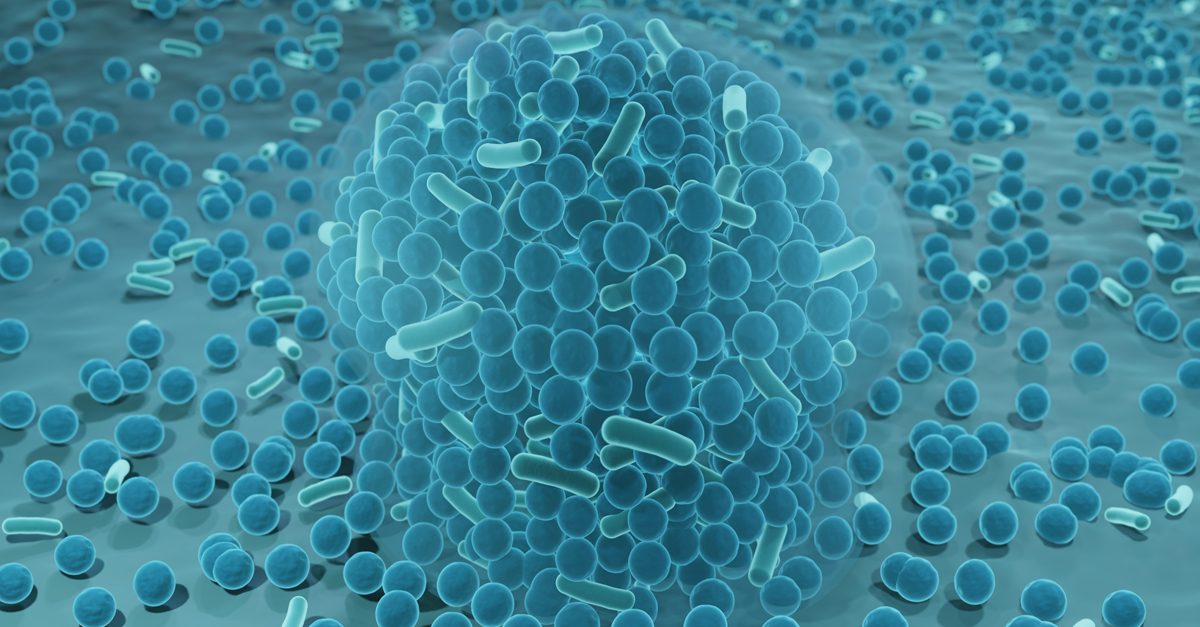
On a microscope slide, biofilm looks like a dense, slimy community of microbes glued together. On real-world surfaces, it is an invisible barrier that can protect pathogens from the very products intended to remove them. Understanding how biofilm forms, and how modern healthcare surfaces help it persist, is essential to maintaining clean, safe healthcare environments.
How biofilm forms
Most microbes in nature do not live as free-floating single cells. They prefer to attach to surfaces and form structured communities encased in a self-produced matrix of extracellular polymeric substances (EPS)—a mix of polysaccharides, proteins, lipids, and extracellular DNA. The process typically starts when planktonic (free) cells encounter a surface. The cells’ primary attachment to the surface is weak and reversible, but as they produce adhesins and begin to secrete matrix material, the attachment becomes stronger and irreversible.
Once attached to a surface, the microbes multiply and organize into microcolonies. These colonies grow into mature, three-dimensional biofilms with channels that allow nutrients and waste to move through the structure. Within this matrix, cells change their gene expression, slow their growth rate, and coordinate behavior through quorum sensing.
The final biofilm stage is dispersion: Some cells escape the matrix and return to a free-floating state, ready to colonize new surfaces. This continual cycle is one reason environmental contamination can reappear even after cleaning.
Why biofilm resists cleaning
From a microbiology perspective, biofilm’s highly effective survival strategy has major implications for the cleaning and disinfection of healthcare surfaces. Surface-attached cells and biofilms are significantly less susceptible to biocides, antibiotics, and physical stress (scrubbing) than their free-floating counterparts. The EPS matrix acts like a physical and chemical shield, slowing the penetration of disinfectants and binding or neutralizing the active ingredients before they reach cells deep in the biofilm.
The organisms inside a biofilm are physiologically different than single microbes. Many grow more slowly and may enter a stress-tolerant state that protects them from agents that target rapidly dividing cells.
On top of that, biofilms on environmental surfaces are often mixed communities. Different species can protect one another, share resistance genes, and create microenvironments that further reduce the impact of cleaning and disinfectant products.
The result is a surface that looks visually clean yet still harbors a well-established biofilm that survives routine cleaning and disinfection cycles. In this state, vegetative bacteria can persist for weeks or months on hospital surfaces and may not be evenly recovered during environmental sampling.
Biofilm on dry surfaces
Biofilm is often associated with wet environments—drains, tubing, and indwelling devices—but research published in the Journal of Hospital Infection found that biofilms can also form on dry hospital surfaces. Microbes can survive in a desiccated state in dust, organic residues, and microenvironments on surfaces, then use intermittent moisture from cleaning processes, spills, or human touch to grow and rebuild their matrix.
Healthcare surfaces can unintentionally support attachment and biofilm formation. Many common materials have microscopic scratches, pores, or seams that create protected niches where moisture and soil accumulate, protected from disinfectants. Surface energy, texture, and chemistry can increase microbial adhesion, especially when combined with the organic load (body fluids, skin cells, product residues) that inevitably build up in clinical environments.
Repeated cleaning with detergents that remove loose soil, but do not disrupt the biofilm matrix, can leave a “conditioned” surface behind—a thin layer of organic material that improves microbial attachment the next time organisms land there. Over time, these conditioned surfaces can enable dry-surface biofilms to become a persistent source of contamination in patient rooms and on high-touch areas and equipment surfaces.
Rethinking clean
Knowledge of biofilm on healthcare surfaces changes the basic question from “Did we wipe the surface?” to “Did we disrupt and remove the attached community?” Traditional testing methods and product claims based on planktonic microbes do not always reflect real-world performance against surface-attached cells and biofilms.
Effective cleaning strategies must consider:
- Surface design and material selection that reduce microbial attachment and make biofilm formation more difficult.
- Cleaning chemistries and tools validated for their ability to break up biofilm matrix, not just kill free-floating organisms.
- Procedures that emphasize mechanical action, correct contact time, and routine disruption of high-risk biofilm reservoirs (for example, around sink areas, bed rails, and shared equipment).
Biofilm may be invisible, but its impact on environmental hygiene and patient safety is very real. By understanding how microbes attach, organize, and protect themselves on surfaces, healthcare leaders can better evaluate disinfectants, redesign cleaning processes, and work with environmental services teams to move beyond “looks clean” to environments that are truly clean at the microscopic level.
Learn More at the ISSA Show
Join the Healthcare Surfaces Institute at ISSA Show North America for the panel discussion, Biofilm: Beyond Disinfection—Breaking Through the Protective Matrix in the Healthcare Environment, on Monday, Nov. 16, 11:30 a.m. to 12:30 p.m., featuring Darrel Hicks and Nancy Schlossberg.