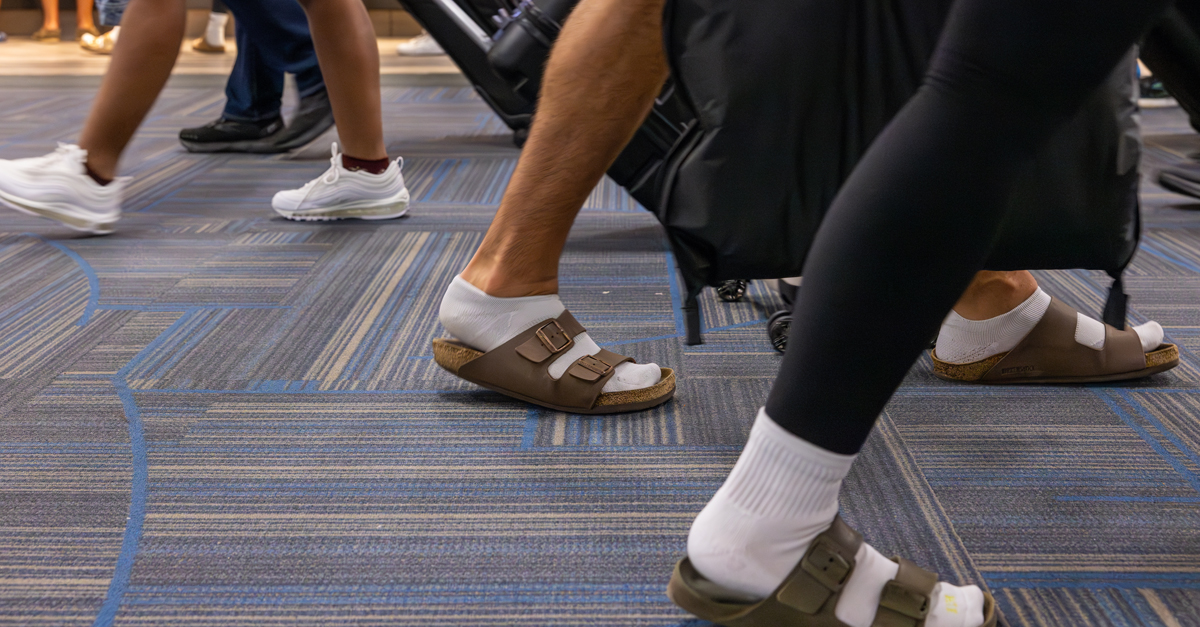
The straightforward solution to carpet maintenance is regular vacuuming and deep cleaning. However, that solution is far from simple in busy public buildings with near-constant foot traffic.
As the director of customer experience with Diverse Facility Solution’s (DFS) group that manages Chicago Midway International Airport, Juan Corral is accustomed to balancing carpet care needs with traveler safety. “Midway has a long, carpeted hallway that leads to a terminal gate area, and it’s challenging navigating through passengers without creating some type of accident,” he explained.
Marty Jollette, general manager and director of training for Renue Systems, which services hotels and other hospitality venues, said formulating a carpet care plan is necessary to protect busy facilities and their visitors.
“Map out the facility, then create a plan for servicing it or hire a professional service to do this for you,” Jollette said. “Schedule carpet care for whatever makes sense for your particular facility, first, second, or third shift, keeping in mind drying times.”
Set your schedule
As a first step, both Corral and Jollette recommend regular vacuuming to keep on top of dirt in heavily trodden carpet. “Identify heavily used areas and vacuum them daily, and sometimes even more often depending on the weather and what people are tracking in,” Jollette said. “If a facility is busy and it is hard to work around people, schedule vacuuming before a facility opens or after it closes. For facilities open 24 hours a day, pick the slowest time of the day.”
To avoid getting in the way of travelers, DFS crews vacuum when the airport is closed from 10 p.m. to 3:15 a.m. “But we will vacuum during business hours if there is a spill that needs immediate attention,” Corral said.
After daily vacuuming and spot cleaning, the next step is interim carpet cleaning. Renue Systems crews favor low-moisture methods, such as encapsulation, in which they place a chemical on the carpet that crystallizes the soil. These crystals then rise to the top of the carpet fibers so crews can vacuum them. “This is a low-moisture method of cleaning with quick drying times compared to hot water methods that can take several hours,” Jollette said. “After encapsulation, carpet will dry in minutes, or an hour at maximum, depending on how soiled the carpet was, the humidity outside, the facility ventilation, and the use of air movers.”
To allow for drying time, DFS crews schedule carpet interim cleanings twice a month during the five-hour overnight shift. “We’ll clean about 80% of the carpet; it takes 20 to 25 minutes to dry,” Corral explained. “Then we’ll clean the remaining 20% so the entire carpet is never wet at the same time.”
The final cleaning step is restorative, which is reserved for heavily soiled carpet, and involves a combination of encapsulation and hot water extraction. Drying times depend on the amount of hot water needed. “If you are in a facility where you are just removing dry soil, that is going to need a lot less hot water than if you are in a restaurant or manufacturing facility, which would have stickier soils that are harder to get out of carpet,” Jollette explained.
Choose your equipment
Once you have the cleaning schedule set, choose equipment that enables your cleaning crew to vacuum quickly and efficiently. Jollette recommended wider vacuums that can clean a large space with fewer passes. Industrial vacuums often feature 30-inch vacuum heads, large enough for a wide cleaning path but compact enough to fit through a standard door. They also feature more powerful motors for lift and suction than residential cleaning equipment.
“You can vacuum 10,000 square feet per hour with a standard industrial vacuum, versus 2,800 square feet with an upright residential model,” Jollette explained. “If the facility you’re vacuuming is really large, like a convention center, you can go with a ride-on vacuum.”
As industrial vacuums feature bags instead of canisters, Jollette recommends using HEPA-certified bags for improved filtration efficiency, protecting building visitors from allergens and other airborne particles. “Either the bag or the vacuum itself should be HEPA-certified,” he said. “Most industrial vacuums are a combination of both.”
And don’t overlook cord length. Jollette recommends vacuums with 75 feet of cord, so operators don’t need to unplug their units and find a new electric outlet constantly.
DFS crews at Midway Airport have recently switched from cord vacuums to battery-operated models. “Just last year, we were using cord vacuums, which made it a challenge to vacuum during the day as we didn’t want to create a tripping hazard for airline passengers navigating the airport,” he said. “When we transitioned from cord vacuums to upright battery-operated vacuums, it became easier to maneuver around the airport, without stopping to unplug and plug the vacuums or creating tripping hazards for people coming in with luggage and kids who want to cross over to the gates.”
Once you have found the ideal vacuums for your facility, don’t neglect their maintenance. “Check the vacuum lift and the rotating brushes, change the bags often,” Jollette said. “A well-working vacuum is one that gets regular maintenance.”
Prioritize long wear
As replacing worn carpet can disrupt facility operations, high-traffic facilities prioritize long-wear carpet made of nylon or polyester fibers.
“Synthetic fabrics are easier to clean and less expensive than wool,” Jollette said. “Uncut fiber loops or Berber, looped, carpets are a very common choice due to superior durability and resistance to crushing.”
The Carpet and Rug Institute’s texture, appearance, and retention rating (TARR) system can help facilities choose carpet that stands up to heavy foot traffic. Scores range from 2.5 for moderately durable carpet to 3.5 or more for highly durable carpet.
Even the most durable carpet needs protection from tracked-in soil. Facilities that install walk-off matting protect their flooring assets. “The right amount of walk-off matting in the right areas will capture most of the soil load coming from outside,” Jollette said, recommending 50 feet of matting at entryways.
Regular cleaning of a facility’s hard floors will also help protect carpeted surfaces. “If your facility includes a commercial kitchen with a tile floor and the tile is greasy, the carpet will be too,” Jollette warned. “Keeping hard surfaces clean through dry and wet mopping will benefit the carpet around it.”
Ensure hassle-free replacement
Eventually, even the most durable, best-maintained carpet will need to be replaced. To avoid disrupting facility operations for an extended period, choose carpet that does not entail a long installation process. Midway Airport uses nylon fiber carpet tiles for ease of replacement.
“The airport generally puts in new carpet every six to 10 years, but if a section of it is damaged before then—maybe someone spills coffee on it, and the stain sits too long—it is easy for us to remove a carpet tile and replace it instead of replacing the entire carpet,” Corral said.
Best practice for carpet replacement is every five to seven years in high-traffic areas, such as entranceways and lobbies, Jollette advised. Common reasons for carpet replacement include mold or stain damage, safety issues with torn seams, or an outdated style that does not mesh with the building’s aesthetics.
To minimize installation time, make sure the carpet you want is in stock and does not require slow-drying adhesives or is difficult to install due to complex patterns or borders. “Pick the right company to do the job,” Jollette said. “One that can install it effectively and at a time that makes sense for your facility, on the weekend, over a holiday, or overnight.”