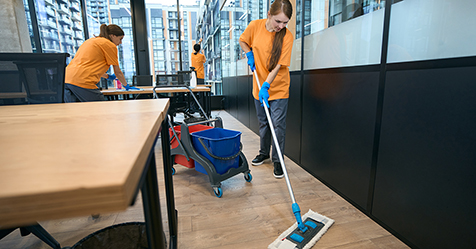
Labor woes remain the top concern among facility managers and supervisors overseeing in-house custodial workers, followed by budget limitations and the spread of infectious diseases.
Participants in Cleaning & Maintenance Management’s 2026 In-House/Facility Management Benchmarking Survey weighed in on the causes of staffing and retention challenges, ranging from a shortage of skilled candidates and a lack of fair compensation to competition from other facilities and complications arising from immigration crackdowns. One survey participant wrote that “attracting quality candidates to the industry as a preferred
career option” is a challenge because “it is still often viewed as a low-skill, low-knowledge, low-income career choice.”
In response to these staffing challenges, facility supervisors are seeking new ways to retain workers. A new question introduced to the survey this year found most respondents (53%) relied on training and certification opportunities to enhance employee loyalty, followed by nonmonetary incentives, such as meals, gifts, and awards (a tactic favored by 43% of survey respondents), and mentoring programs (a solution chosen by 39%).
Stretched budgets
Financial constraints ranked as a close second among the top in-house cleaning industry concerns, with survey respondents expressing frustration over the cost of cleaning supplies, equipment, and staff training. More than half of survey respondents (59%) reported that the cost of implementing cleaning technology is a significant barrier or a concern.
Survey respondents also pointed to the risks budget cuts pose to effective cleaning.
“The more cuts to the budget, the more [facilities] settle into a more periodic-type cleaning model as opposed to a daily cleaning model, and we see more degraded surfaces and an increased risk of infections getting out of control quickly,” explained a survey participant.
Germs and other threats
The spread of infectious diseases was the top threat on survey participants’ minds, chosen by 55% of respondents as the issue most likely to affect facility operations negatively. Other top threats included the impact of tariffs on cleaning supplies and equipment (chosen by 37% of respondents) and natural disasters (29%).
Facility leaders said they rely on staff training, the use of personal protective equipment, and standard operating procedures to help safeguard their facilities against infectious diseases.
“We have implemented layered, practical safeguards focused on prevention, early response, hygiene, ventilation, and staff awareness to reduce the risk of infectious disease transmission within our facilities,” said a survey respondent. “We use disinfectants that are effective against common pathogens and focus on targeted disinfection, rather than over-application, to ensure effectiveness.”
Technology ROI
To aid in facility cleaning and disinfection, most survey participants who plan on buying technology within the year (36%) are purchasing robotic/autonomous equipment. When asked whether cleaning and disinfecting technologies provide a return on investment (ROI) for their facilities, several survey respondents replied that they haven’t used the technologies long enough to know.
“The jury is out. We are piloting robotics and IAQ sensor capabilities in the coming year,” explained a respondent.
Others praised their favorite technologies. “I think autonomous equipment provides the highest return on investment, since it will free up employees to do other detailed custodial work,” one respondent replied. “IoT [Internet of Things] has the highest return on the business metrics, since these internet-connected devices communicate and often reduce energy consumption, which adds to the bottom line,” another opined.
Survey Prize Winners
Congratulations to the survey participants who received $100 Visa gift cards.
- Marc Desciscio, Little Sisters of the Poor, Retirement Homes
- Dale Hamilton, Kettering Health
- Wendy Welker, Georgia Institute of Technology
About This Report
Survey data is based on results from email solicitations to in-house service providers from Feb. 3 to Feb. 25, 2026. Results are self-reported and not based on audited financial statements. Percentages in graphs and charts are rounded to the nearest whole number.
Download the full survey below.