Antimicrobial resistance (AMR) is one of the top global public health threats, according to the World Health Organization (WHO). Scientists estimated that bacterial AMR was responsible for 1.27 million global deaths in 2019 and will cause 10 million deaths by 2050.
The superbugs cleaning professionals combat in healthcare settings are a result of AMR, which occurs when germs, including bacteria, fungi, and viruses, develop the ability to defeat the antibiotics/drugs designed to kill them.
All organisms, including people, have survival instincts and biological mechanisms to fight back, explained Joanna Mills, a registered nurse and system director of infection prevention at John Muir Health, Walnut Creek, California. She added that AMR is not a new occurrence. Alexander Fleming, who discovered penicillin in 1928, warned that “microbes are educated to resist penicillin.”
Infection control progress
Since the rise of superbugs, infection control practices have become more evidence-based, standardized, and proactive.
“We’ve seen stronger emphasis on hand hygiene, environmental cleaning, and antimicrobial stewardship programs, along with enhanced surveillance and rapid diagnostic testing,” said Rodney E. Rohde, a Regents’ professor and associate director of the Translation Health Research Center at Texas State University System, San Marcos. “Education and cross-disciplinary collaboration—especially between infection prevention, laboratory science, and environmental services—have also improved. Together, these efforts create a more resilient infection prevention culture that helps contain resistant pathogens and protect patients and staff alike.”
Improvements in disinfection and sterilization of high-risk environments, such as surgical suites and intensive care units, in addition to isolation standards, also continue to evolve.
“I believe that pursuing the research needed to establish a validated and effective cleaning and disinfection methodology will open the door to discover and develop strategies to make significant improvements in prevention and patient outcomes,” Mills said.
As the industry studies how to clean surfaces effectively, it has established best practices for cleaning and disinfection in healthcare and learned that personal protective equipment (PPE) can keep staff safe and prevent them from transmitting organisms to other patients, explained Sarah Wilkerson, system executive director of infection prevention at Providence St. Joseph Health, Everette, Washington. The industry also uses broader surveillance techniques to look for these organisms.
“We’re trying to identify them early, so that we can put in place targeted interventions that can help prevent the spread that could potentially turn into an outbreak,” Wilkerson said.
Healthcare setting improvements
Healthcare professionals face significant challenges when dealing with superbugs, including limited treatment options, diagnostic delays, staff shortages, and the constant pressure to maintain strict infection control amid heavy workloads, Rohde said. Misinformation and inconsistent compliance can also undermine prevention efforts. Fortunately, new tools to address these challenges include rapid diagnostic technologies, antimicrobial stewardship programs, and multidisciplinary teams.
“By integrating science, communication, and collaboration, we’re steadily improving our ability to detect, manage, and prevent resistant infections in healthcare environments,” Rohde said. “In the medical laboratory setting, we all need to work together to raise awareness surrounding current antimicrobial susceptibility testing breakpoints. These are challenges for clinical and medical laboratories to update their testing methods to keep up with new drug resistance patterns, and face hurdles like regulatory clearance and manufacturer delays.”
Mills believes the biggest challenges in superbug prevention stem from three factors patients are exposed to before they arrive at acute care hospitals: the environment they came from, including skilled nursing facilities; the
treatment they received, including antibiotics; and the healthcare practices of their care team, such as isolation and disinfection. Unfortunately, standards and requirements are not consistent.
“The pandemic illustrated these issues and exacerbated the resistance patterns and emerging urgent and serious organism threats,” Mills said.
Superbugs also can spread easily on surfaces, such as equipment. “While we know that it can be challenging to clean and disinfect some of the healthcare surfaces, we now know we need to be looking at the different types of surfaces and what is recommended to clean those effectively,” Wilkerson said.
Collaboration between environmental services (EVS), nursing, engineering, supply chain, and infection prevention also is necessary to consider the environment, identify which surfaces need cleaning, and determine how teams can clean most effectively without using multiple products. Managers also must delineate each team’s role. “It can be really confusing to teams, because it can be a shared responsibility to clean the healthcare environment,” Wilkerson explained.
As hospitals acquire pieces of equipment, furniture, buildings, etc., teams need to select surfaces that can be cleaned and disinfected easily. “We know that some of the older buildings have a real challenge with being able to keep those clean just because the surfaces degrade over time,” Wilkerson said. “It’s a great opportunity as we’re bringing in new products to be thinking about how to ease our way in the future.”
Best practices adaptation
Professional organizations have developed and published cleaning and disinfection standards specific to patient populations and specialty services. Still, the specific practices related to the general medical surgical areas are
lacking, complicated by the recommendations of manufacturers of medical devices, hospital furniture, and construction materials, Mills explained. “Often, the instructions for use (IFU) related to cleaning and disinfection are insufficient and/or not defined, and the cleaning practices are deferred to hospital standards,” she said.
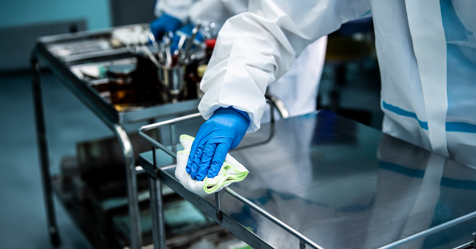
The best cleaning practices for reducing superbugs start with consistency and adherence to evidence-based protocols. This includes routine, thorough cleaning of frequently touched and shared surfaces, proper use of Environmental Protection Agency (EPA) registered disinfectants effective against resistant organisms, and proper contact times. Staff training, hand hygiene, and clear communication between a multidisciplinary team is essential. Regular audits, monitoring, and feedback also ensure compliance.
“Ultimately, a culture of shared responsibility—where everyone understands their role in infection prevention—is key to minimizing the spread of superbugs in healthcare settings,” Rohde said.
Wilkerson also believes it is important to have rigorous environmental cleaning practices for patients with known AMR organisms. For example, place them on transmission-based precautions or in isolation, meaning that staff
entering that room might need to wear a gown and gloves. Hand hygiene protocols also help ensure staff properly disinfect their hands before entering a room to care for the next patient.
Care teams should use EPA-registered disinfectants for resistant organisms, focusing on regular decontamination of high-touch surfaces.
“They may even want to increase the frequency that they normally would clean those surfaces when there’s a risk or a concern that we have this type of a pathogen in the facility,” Wilkerson said. Teams often want to validate the effectiveness of their cleaning. Using technology, such as adenosine triphosphate (ATP) testing or a black light, they can check surfaces post-cleaning. “It’s a way just to validate that the training that we put in place is working appropriately,” Wilkerson said.
Handling linens and trash properly and disposing of them appropriately is also important. Standard precautions for every patient encountered also prevents transmission of unknown organisms. This includes wearing gloves, practicing hand hygiene, and cleaning and disinfecting surfaces to deter teams from spreading unknown organisms. Additionally, some healthcare facilities may consider advanced technologies to reduce these organisms, including ultraviolet (UV) light or hydrogen peroxide vapor to disinfect a room after a patient is discharged, in addition to regular cleaning, Wilkerson explained.
Team education
Staff training is one of the most powerful tools for combating superbugs. Well-trained personnel understand how infections spread, why protocols matter, and how their daily actions directly impact patient safety. Ongoing education builds confidence, consistency, and accountability across teams, Rohde said.
Mills agrees that educating and training EVS personnel is critical to effective cleaning and disinfection. “An understanding of how infections/organisms are transmitted, cleaning techniques, and chemical agents is the groundwork of effective infection control and prevention,” she explained. “Housekeepers are members of the healthcare team and have equal responsibility to provide the safest environment for patients and staff.”
Self-education is imperative for stopping the spread of superbugs, Wilkerson added. Having a strong training program also embodies validation and competency. “It’s a two-step process, making sure that they learned it, and then that they can actually put it into practice,” she explained.
Additionally, teams must understand cleaning product instructions, such as contact time requirements for disinfectants. Staff must know what type of PPE to use. Hospitals also must foster a culture of safety that empowers the team to speak up if they see something that does not seem quite right, Wilkerson added.
Emerging superbugs
With the global burden of AMR increasing, the WHO reports rising rates of drug-resistant infections, with limited treatment options and gaps in surveillance. Cleaning professionals should expect greater emphasis on a “One Health” approach that recognizes how human health, environmental surfaces, animals, and the built environment intersect with superbug threats.
“Environmental and climate-linked factors matter; warmer temperatures, extreme weather events, compromised sanitation, and more pathogen spill-over increase the risk of superbug spread,” Rohde said.
Meanwhile, new technology is accelerating the capabilities of genetic sequencing, diagnostics, and real-time surveillance. As these technologies become more mainstream, they can help identify resistant strains faster, Rohde said. However, the pipeline for new antibiotics is still weak, so prevention remains key.
Cleaning professionals should focus on pathogens the CDC has identified as “urgent threats” that pose public health risks and require urgent, aggressive action. These include:
- Carbapenem-resistant Acinetobacter baumannii (CRAB)
- Candida auris (C. auris)
- Clostridioides difficile (C. diff)
- Carbapenem-resistant Enterobacteriaceae (CRE)
- Drug-resistant Neisseria gonorrhoeae
Healthcare interventions for these superbugs include surveillance, control and prevention practices, antibiotic stewardship, and reporting, along with public health partnerships, Mills said. Wilkerson believes the most concerning threat to cleaning professionals in healthcare is C. auris, a multi-drug-resistant fungus that spreads primarily through contact with contaminated surfaces and equipment. C. auris first emerged in 2016, but since then, the U.S. has seen a 9,000% increase in confirmed cases, according to the CDC. Additionally, more cases are spreading to states that have not seen C. auris before.
Healthcare facilities have implemented interventions to prevent the spread of C. auris, such as interviewing patients about their risks. When treating patients who may have been exposed, facilities can use precautions including
appropriate disinfectants and PPE.
Rohde added that persistent, rapidly spreading, and increasingly resistant bacteria, such as Klebsiella pneumoniae and Escherichia coli (E. coli), are showing high levels of resistance in hospital/healthcare environments. For example, more than 40% of E. coli cases in some regions are resistant to third-generation antibiotic cephalosporins. Fungal superbugs and multidrug-resistant organisms in the environment may also become more relevant for cleaning crews, although they are more pronounced in the clinical infection-prevention sphere, Rohde added.