In today’s business environment, disruption isn’t episodic—it’s constant. Economic volatility, geopolitical tension, workforce shifts, climate emergencies, cyber threats, and regulatory pressure now overlap and accelerate, redefining how facilities must design, lead, and sustain security.
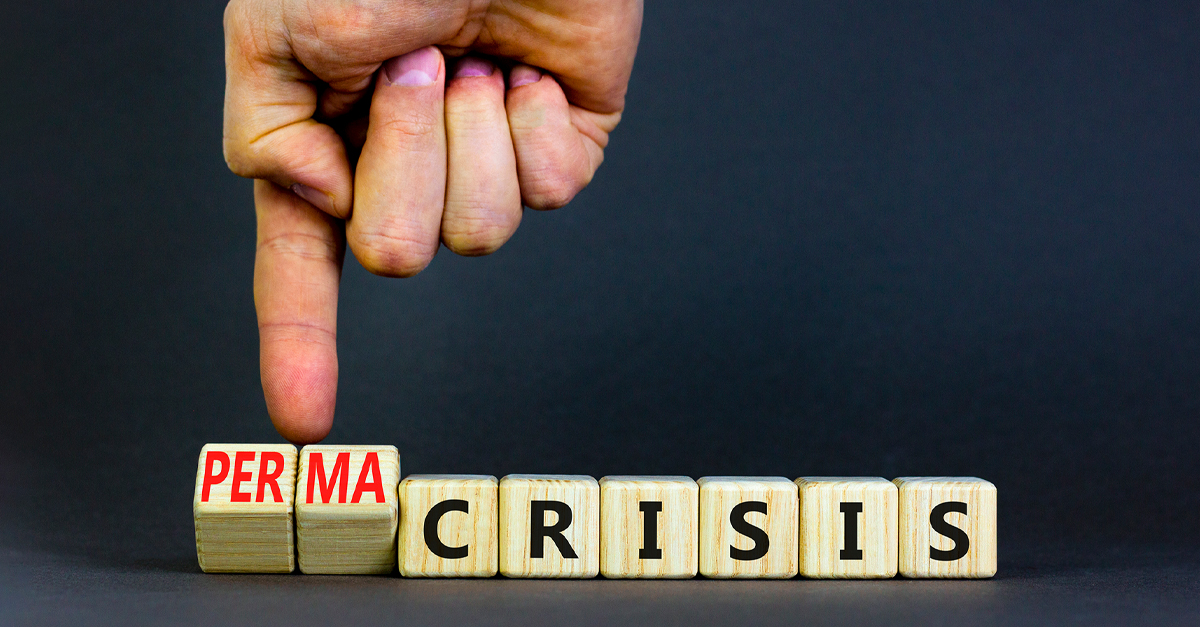
This disruption condition has a name: permacrisis. For facility leaders and safety managers, it demands a move from reactive protection to resilient, adaptive operations. Traditional models built for static threats and predictable timelines can’t keep pace. In a permacrisis environment, resilience, adaptability, and decision speed matter as much as technology—especially for teams tasked with keeping facilities safe and operational every day.
Continuous challenges
For years, physical security planning revolved around defined scenarios—storms, incidents, audits—handled in cycles and often siloed from other risk functions. That cadence no longer fits reality.
Permacrisis breaks that model by turning risk into a continuous, cross-functional challenge that touches operations, information technology (IT), human resources, procurement, and compliance. Threats are now interconnected. A cyber event can disable access control. Labor shortages can thin overnight coverage. Severe weather can disrupt supply chains and force rapid shutdowns. Meanwhile, social and political tensions raise the likelihood of targeted incidents across facilities.
Security can’t be “switched on” only in emergencies. It must be embedded in daily operations, continuously monitored, and able to flex with shifting conditions—without slowing cleaning or maintenance services.
Cloud flexibility for resilience
Resilience now depends on visibility and scalability across locations, not just at single sites. That requirement is driving a shift from one-size-fits-all security program deployments to hybrid, cloud-flexible models that centralize control while honoring local needs.
Cloud-enabled security platforms let teams centrally manage access, video, alarms, and analytics while adapting to site-specific workflows. This ability results in faster updates, fewer blind spots, and consistent standards across vendors and shifts.
Equally important, cloud-based systems support rapid updates, better integration with building systems, and continuity during disruptions. In a permacrisis world, rapid adaptation isn’t optional; it’s operational hygiene.
AI-accelerated response
Artificial intelligence- (AI) powered detection and analytics are changing day-to-day routines. In high-noise environments—with constant alerts, data overload, and competing priorities—AI helps reveal what matters so teams can act sooner and more confidently.
Used responsibly, AI can identify anomalies, reduce false alarms, and flag early signs of escalation. This results in fewer unnecessary disruptions, faster triage, and better allocation of limited personnel, especially across large facilities.
However, AI raises responsibilities concerning transparency, data governance, and bias mitigation. Facilities, security, and compliance leaders should partner to set guidelines on clear policies, audit trails, and training to ensure trust alongside speed.
Joint cyber and physical security
Permacrisis is accelerating cyber–physical convergence. Now that access control, cameras, building management, and life-safety systems are networked, they could become exposed to digital threats that could lead to physical consequences.
A breach may start in the cloud and end at a door that won’t lock, or at a facility that can’t restart safely. Managing cyber and physical separately—with different teams, tools, and leadership—creates risk. The path forward is a unified strategy with shared intelligence, and coordinated response plans that include personnel from IT, security, facilities, and operations.
Transparency leads to trust
Meanwhile, compliance pressures are rising, especially around surveillance data, biometrics, and AI use. Facilities leaders must balance safety with privacy and transparency when they document how data is collected, secured, and used.
In permacrisis, trust is a form of resilience. Facility employees and visitors, along with business stakeholders, need confidence that security measures are proportionate and values-aligned. Clear policies, strong governance, and proactive communication build legitimacy and reduce friction during disruptions.
Compressed decision cycles
One of the most overlooked impacts of permacrisis is its effect on leadership. Sustained disruption compresses decision timelines, amplifies uncertainty, and widens the gap between perceived risk and actual risk.
Security leaders are often expected to provide clarity when information is incomplete, and conditions are changing rapidly. Without strong communication channels and executive alignment, organizations may overreact to low-probability threats while missing slow-building, high-impact risks.
Prepare for this expectation by investing in your security team as much as you invest in security platforms. When training your team be sure to:
- Prepare them to make faster, higher-stakes decisions.
- Warn them they will need to regularly test their assumptions.
- Set clear expectations about what security data can and cannot tell them.
Keeping pace with crisis
Resilient organizations treat security as a strategic enabler of business continuity, not just a protective layer. Their approaches to achieve continuity through crisis include:
- Designing security programs that are flexible, integrated, and built for constant change. These programs are embedded in daily facility operations.
- Using intelligence and analytics to cut noise and improve situational awareness across sites and shifts.
- Aligning cyber, physical, and operational risk under a unified strategy and coordinated playbooks.
- Preparing leaders and frontline teams to make faster decisions with confidence, and to document their decision paths.
- Embedding governance, ethics, and transparency from the start of security actions to sustain trust during disruption.
Permacrisis has changed the process of providing security for facilities. Industry leaders aren’t preparing for the next disruption—they’re leading through it. Those who embrace flexibility, intelligence, convergence, and trust will help their organizations move forward in an unpredictable world.