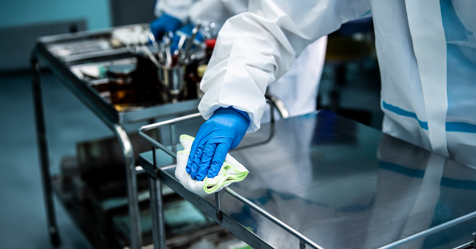
Biohazard incidents can happen anywhere—schools, offices, healthcare facilities, public spaces, transportation hubs, and commercial buildings.
When cleaning professionals encounter blood, bodily fluids, infectious materials, or other potentially hazardous contaminants, the stakes climb well beyond routine cleaning. For ISSA members and the global cleaning and facility services industry, knowing how to properly respond to biohazard situations is about safety, risk reduction, worker protection, compliance, and public health.
It is also, right now, about visibility. A recent hantavirus outbreak on a cruise ship drew heavy media attention, yet one question went almost entirely unasked across the coverage: Who is doing the cleaning?
To examine that gap and what the industry needs to do about it before a busy summer arrives, Dr. Gavin Macgregor-Skinner, senior director at ISSA, shared tips on readiness, responsibility, and the opportunity in front of the value chain.
A missing piece in the headlines
Macgregor-Skinner said the recent hantavirus outbreak on a cruise ship has alarmed him, not because of what was reported, but because of what was not.
“There’s one big thing that’s missing out of all the stories that we’ve been reading, is ‘who’s doing the cleaning?’” he said. “Are they trained to clean up infectious disease materials, biohazards? Do they have the correct PPE to protect their safety?”
Passengers were moved from the ship to buses, then onto a plane, then either to hospitals or to their own homes for quarantine. At no point in the public conversation, Macgregor-Skinner said, did anyone address how the contaminated spaces were handled.
“There’s been no mention of how we clean up biohazard materials, you know, urine, vomit, diarrhea, contaminated surfaces, indoor air,” he said. “We’ve had no mention of who cleaned the ship, who cleans the buses, who cleans the plane, who cleans the hospital rooms, and who cleans the homes.”
A business opportunity hiding in plain sight
The silence around cleaning, Macgregor-Skinner said, is exactly where the industry needs to step in. He leads the Making Safer Choices program at ISSA and works in exposure science, the study of how people become infected or sick from the indoor environments they occupy.
“If no one’s going to talk about cleaning in an infectious disease outbreak like hantavirus on a cruise ship that got so much media attention, then it’s up to ISSA and our members to create awareness,” he said. “I think right now we have an enormous business opportunity across the value chain of the clean industry, if they can do this one thing.”
That one thing is closing what he calls the knowing-doing gap. Manufacturers, distributors, facility managers, anyone who sells, buys, or uses cleaning products and equipment, must know how to clean up vomit, diarrhea, urine, and blood—and has to be able to explain how they make indoor spaces safe and prevent infections.
Why this summer matters
Macgregor-Skinner pointed to a convergence of events that will make the next several weeks unlike any recent summer for the industry. The FIFA World Cup brings 104 games over a six-week period across 48 teams, with an estimated 10 million people traveling to mass gatherings. In the middle of the tournament falls July 4th and the 250th anniversary of the United States.
“Cleaning industry workers, people across the value chain for the clean industry, will not be taking vacation this summer,” he said. “It’s going to be too busy.”
That volume of activity, across stadiums, hotels, restaurants, convention centers, buses, trains, planes, and cars, raises the baseline risk substantially. And the hazards themselves do not change based on the venue.
“Anything that is wet that comes out of a person’s body has the potential to cause harm,” Macgregor-Skinner said. “Vomit, diarrhea, urine, mucus, pus, saliva, blood. You can clean it. Professionals can clean it properly and safely, so it’s no longer a hazard from any surface—that’s hard surfaces, soft surfaces, porous, non-porous, carpet, tile, wood, you name it, but we have to tell the world how we’re doing it.”
The reactive cycle has to end
A recurring frustration in the industry is the blip pattern: a cruise ship outbreak, a news cycle, a brief spike in conversation about disinfection, and then a return to baseline. Macgregor-Skinner said the professional cleaning industry should not operate that way.
“We are seeing communities, we’re seeing people, they’re still leaving a lot to chance,” he said. “They’re crossing their fingers, and they’re hoping for the best. The professional cleaning industry does not do that. We manage air, water, and surfaces in the built environment. We clean and maintain them and disinfect them to ensure that they are safe for every user that goes into that indoor space.”
Don’t assume anything about what’s in front of you
The word biohazard, Macgregor-Skinner pointed out, is a combination of biological and hazard. Cleaning professionals need to treat every bodily fluid as an unknown.
“We don’t make things up, we don’t assume, and just because you don’t know, you don’t think, oh, there’s no bacteria, there’s no viruses, there’s no parasites, there’s no toxins,” he said. “Don’t assume that. They could be there, and they could pose a threat to your health and hurt you.”
That posture drives two practical questions for every worker on every job. Are you wearing the correct personal protective equipment to protect your eyes, nose, and mouth? Are you using the correct cleaning equipment, tools, and products to clean safely?
What the industry needs to do now
When asked what he wants the industry to do next, Macgregor-Skinner did not ask for a checklist. He asked for a conversation.
“It’s absolutely critical that the cleaning industry comes together under a community of practice, that’s what we do under the Making Safer Choices program,” he said. “They need to not just say they know there are hazards. They know there are risks, they know how to use safe cleaning methods, they have to
tell people how they’re going to do it. And then they actually have to do it, and they have to do it consistently every time.”
His own preparation work has been underway for more than a year, in coordination with federal, state, and local governments and the facilities tied to the FIFA World Cup and July 4th celebrations. The window has not closed for the rest of the industry to join in.
“It’s still not too late for the cleaning industry right now to say, right, across the value chain, manufacturers, distributors, anyone who sells cleaning equipment and products, cleaning companies and their workers, facility managers, just anyone who cleans, can you safely clean up vomit, diarrhea, urine, blood?” he asked. “If you say yes, then work with ISSA so we can tell that story. We can show that we know what to do before the emergency becomes and quickly turns into a disaster.”
The payoff, he said, is both protective and promotional. The public gets to enjoy the mass gatherings ahead. The industry gets to be seen for what it does.
“The cleaning industry will not be taking a vacation this summer,” Macgregor-Skinner said. “We will be working, and people have to know what we do.”
It is, he added, an exciting time if the industry chooses to act like a team.
“If we come together as a community of practice, if we just tell people, this is how we clean, and this is how we do it safely.” Use this link to learn more and contribute comments.