We have spent the better part of two decades making buildings tighter through better insulation, less air leakage, and more efficient mechanical systems—all sensible responses to rising energy costs and a changing climate. But a catch arises, and the problem is very relevant to facility and custodial teams.
When you seal a building to keep energy in, you also keep pollutants in. Whatever finds its way inside—smoke from a distant wildfire, pollen from outdoors, dust from a renovation, or fumes off a fresh coat of paint—now lingers far longer than it once did.
The average American spends about 90% of their time indoors, according to a study funded by the Environmental Protection Agency (EPA). Unfortunately, the EPA also found that concentrations of some indoor pollutants are two to five times higher than those outdoors (and occasionally far higher). Poor indoor air quality (IAQ) negatively impacts our health in numerous ways, not least our respiratory systems.
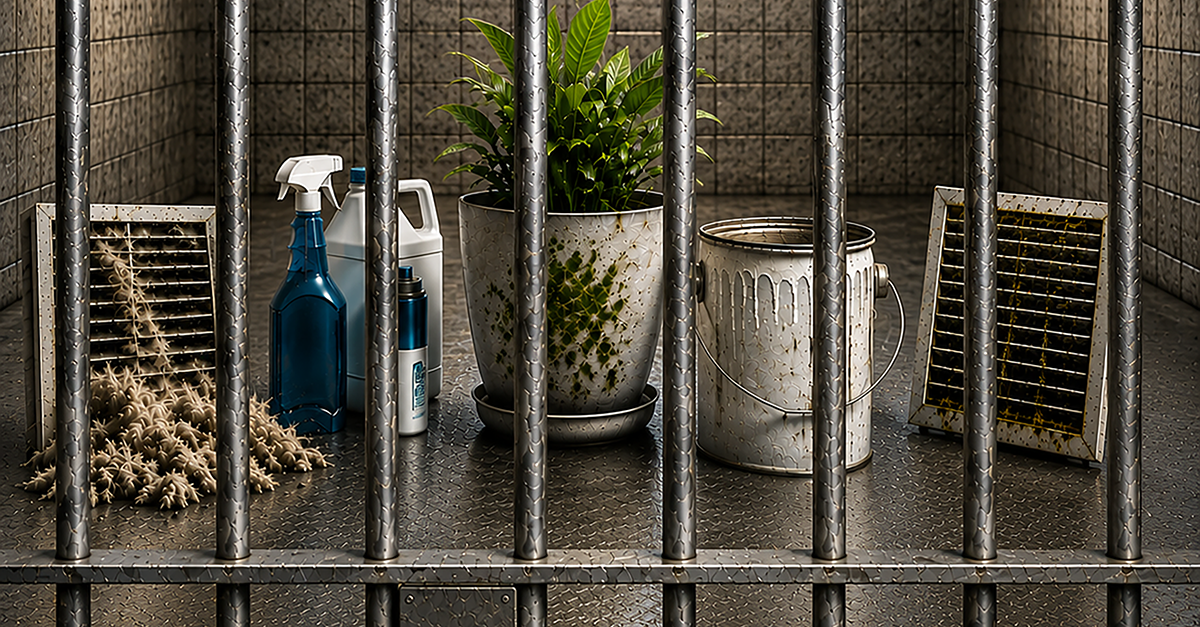
Good IAQ starts with facility design, but once the construction is completed, IAQ becomes the responsibility of the building’s maintenance teams. Fortunately, most of the poor IAQ culprits are ordinary building elements that cleaning and maintenance professionals handle all the time: the HVAC system and its filters, the flooring underfoot, the insulation inside the walls, and the paint on the surfaces around us. Knowing where to look is, as they say, half the battle.
Neglected HVAC filters
If you are hunting for the source of a stuffy building, the air handling system is the obvious first stop, and the filter is the most likely neglected part. Before focusing on the filter, however, it is worth checking that the wider system is doing its job.
A large share of air quality complaints trace back to an HVAC system no longer running as it was designed to, explained Sean Goddard, coils and IAQ product manager at Trane. “Over time, factors such as air leakage, clogged filters, improper airflow, unbalanced ventilation, or deferred maintenance prevent a system from effectively managing temperature, humidity, and fresh air exchange,” he said.
The instinct on a tight budget is to buy the cheapest HVAC filter on the shelf and forget about it. “The easiest place to go wrong with filter maintenance and replacement is forgetting the important role filters can play in improving indoor air quality, and then simply buying the cheapest filters available, which likely provide low benefit from an air quality standpoint,” said Andy Fox, filtration and indoor air quality specialist at 3M Filtrete™. “And, don’t forget to change filters regularly! Most filters offer the best overall performance when they are new.”
Filter efficiency, usually expressed as a minimum efficiency reporting values (MERV) rating, reports an air filter’s ability to capture particles between 0.3 and 10 microns. Both the EPA and the Centers for Disease Control and Prevention recommend filters with a MERV rating of 13 or higher for general IAQ, because filters at that level capture at least half of the fine particles that carry allergens, smoke, and virus-containing aerosols. A higher rating usually means higher airflow resistance, so choose a filter designed to balance capture rates and airflow rather than simply buying the densest media available.
Remember that the MERV number is not the whole story. A filter with a lower rating that has been independently tested and verified for allergen removal can still deliver meaningful reductions in common triggers such as pollen and dust mite allergen.
How do you know when your filtration is failing and you need to replace the filter? Watch the system, and don’t simply follow the calendar. In constant-air-volume HVAC systems, fan energy rises when a filter’s airflow resistance climbs too high. In fixed-speed systems, airflow drops when the filter’s airflow resistance is too high.
Both outcomes have consequences; rising fan energy raises the utility bill and falling airflow brings complaints from the building occupants. If overdue or low-quality filters let dust bypass the media, that debris settles on cooling coils and restricts airflow even further. Fox advises having the coils professionally cleaned and moving to a higher-quality filter rather than nursing the problem along.
The HVAC system itself can turn into a pollution source if you don’t manage moisture properly. “In the summer, warmer and humid air contains significant moisture, and if the moisture isn’t managed properly, the HVAC system could become a breeding ground for mold and serve as a pollution source for the building,” Fox warned.
Avoid these risks by having the system professionally serviced well before summer and periodically checking for pooling water. Aim to hold indoor relative humidity between 40% and 50%, which keeps occupants comfortable while discouraging both mold and dust mite allergen proliferation.
Filtration and moisture are not the only suspects for poor IAQ. Goddard recommends seasonal inspections of the HVAC system’s airflow and ventilation balance. “As the seasons shift, airflow, ventilation performance, filtration, and humidity control become key focus areas,” he said. The switch from cooling to heating is a good time to catch what built up over summer: trapped moisture, uneven temperatures, or pressure imbalances. Be sure to inspect ductwork for uncontrolled air leaks, as they pull outdoor pollutants and moisture indoors.
The flooring factor
Flooring is one of the largest surfaces in any building, so it can have a disproportionate impact on the air we breathe. Dust, pet dander, pollen, and mold spores collect in carpet fibers, gaps
between floorboards, and grout lines. The goal is to remove these allergens before foot traffic sends them back into the breathing zone.
No single flooring type is a magic answer to your IAQ problems. Hardwood, tile, stone, and vinyl do not trap allergens in the same way as carpet, but each has a weak point. Dust settles in the crevices between boards and dirt is trapped in grout lines. Some resilient flooring and its adhesives release volatile organic compounds (VOCs), gases that can irritate the eyes, nose, and throat; cause headaches and dizziness; worsen asthma and allergy symptoms; and—with prolonged exposure—carry more serious health risks. Newer treated and hybrid textile floors are beginning to address these issues, but these flooring types still need a proper maintenance routine.
For custodial teams, the methods matter more than the material. The following practices help control allergen levels:
- Keep to a regular vacuuming, mopping, or scrubbing schedule and do not skip the spots behind and under furniture where dust accumulates unseen.
- Manage what comes in the doors. Entryway matting captures much of the pollen, dirt, and pollutants tracked in on shoes before they reach the floor.
- Give grout lines and hard-flooring seams particular attention rather than hoping a general mop will reach them.
- Steam clean carpet and textile flooring at least once a year to lift deep-seated dirt, allergens, and mildew from the fibers.
- Choose certified low-VOC cleaning products, and go easy on scented sprays and air fresheners, which can irritate sensitive airways.
Hazards in the walls
Insulation is the culprit nobody thinks about; once the drywall goes up, insulation is out of sight and out of mind. However, even from inside a sealed cavity, insulation can contribute VOC emissions after installation and release fibers and dust when it is cut or disturbed. If insulation holds moisture, it can create the conditions for mold growth.
Older insulation products often contain materials that impact sensitive airways. Research from the Milken Institute School of Public Health at George Washington University published in the journal Environmental Science & Technology found phthalates and flame retardants in U.S. household dust samples that had accumulated from insulation.
The highest exposure to insulation material occurs when walls are opened during facility renovation, affecting both tradespeople and building residents. To avoid this risk, choose low-emission insulation products that are independently evaluated for dust and fiber release, as well as mold resistance. This choice protects your staff and the building occupants today and for decades ahead.
Lingering paint chemistry
Paint gives off VOC emissions, which off-gas while it dries and can linger long afterward. Although the familiar “new paint” smell usually fades within days, the VOC emissions can remain,
affecting the air quality in schools, healthcare settings, and any facility that cannot be closed for a lengthy period.
A 2021 study by the Harvard T.H. Chan School of Public Health found that improving indoor air, particularly by lowering VOCs and improving ventilation, raised cognitive performance in office settings by as much as 61%. This means that choosing low-emission paint influences not just our health, but how well we think and work inside a building.
Schedule painting on a day and time when the building is at its lowest occupancy rate, and ventilate aggressively during and after. And choose genuinely verified low-emitting products, paying attention to return-to-service time, meaning how quickly a space is safe to reoccupy.
Real certifications
A common marketing tactic allows manufacturers to include terms like “low-VOC,” “nontoxic,” “eco-friendly,” and “hypoallergenic,” on their product labels without proving these claims. A 2020 European Commission review of 150 environmental claims on products found that more than half were vague, misleading, or unfounded.
Inspect product labels for the “selfie seal,” a logo styled to look like a third-party endorsement but awarded by the company to itself. The Federal Trade Commission calls these “performing seals” and acts against them, because it is deceptive to imply independent certification where none exists. The seal is worth exactly as much as the testing (or lack of) behind it.
Legitimate third-party certification is wholly different. It involves testing against a published standard and obligations for ongoing compliance, all handled by an independent body with no stake in the sale. For indoor-air products, rigorous programs evaluate:
- How well a product reduces or resists allergens.
- Multiple measurements of a product’s VOC emissions, often measured at 24 hours and again at 14 days.
- Filter performance under dust loading.
- The ability of air to pass through the filter rather than leak around the edges.
A maintenance mindset
Cleaner air is far more often a matter of maintenance consistency than of groundbreaking ideas or a dramatic overhaul. Basic practices such as the right filter changed at the right time, humidity maintenance, regularly cleaned
floors, and the careful choice of materials make a difference in IAQ. Pair these practices with a healthy skepticism toward any product claim with no testing behind it.
Facility and custodial teams are already on the front line of IAQ maintenance, even though it may not be in the job description. Knowing the usual culprits of poor IAQ—and how to tell a certification logo from a shiny sticker—will ensure their everyday maintenance tasks translate into a healthy outcome for facility occupants.